


Project overview
Smarter logistics starts with better operational decisions.
HeyHoTec designed a logistics optimization and decision-support system that helps businesses plan supply, manage inventory, evaluate distribution strategies, and understand the operational impact of changing constraints.
Rather than optimizing individual activities in isolation, the system connects supply chain planning, inventory management, and transportation feasibility within a unified decision-support framework.
Business challenge
Supply, inventory, and distribution decisions are often planned apart from one another. Capacity limits, replenishment timing, safety stock, and delivery constraints then become visible only after a plan is already in motion. The demonstration brings those decisions into one view, so a business can see how a constraint changes cost and service before the change is implemented.
Supply chain optimization
The weekly plan allocates product across suppliers, warehouses, and retail locations while respecting operational capacities. It answers where product should come from when freight, handling, and capacity limits all apply at once.
Daily inventory and distribution planning
Daily planning coordinates replenishment, inventory levels, safety stock, and delivery lead times. Releases are placed on specific days inside the week, so inventory and distribution stay aligned with the weekly supply plan.
What-if scenario analysis
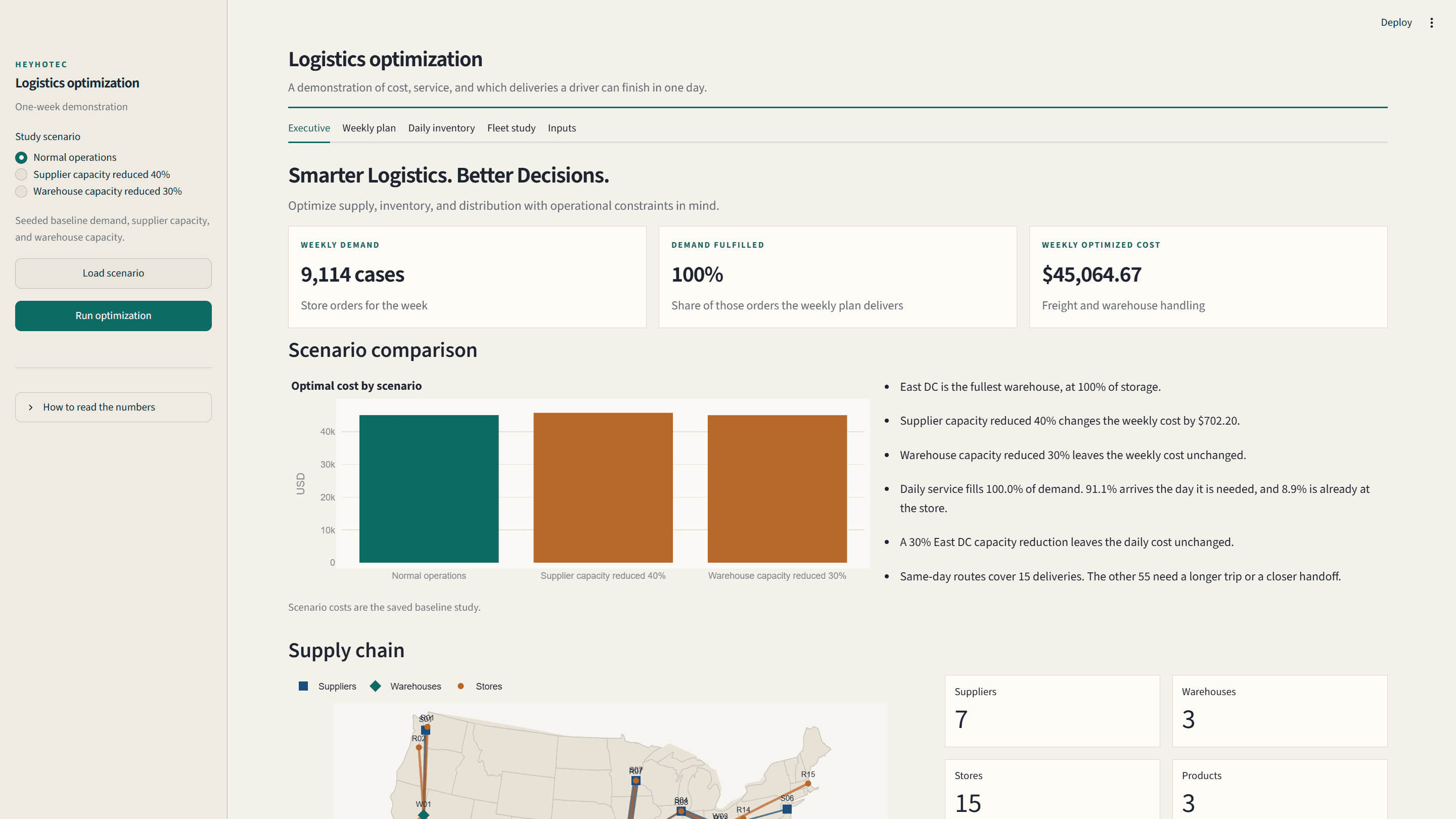
Scenario comparison shows how supplier disruptions or warehouse capacity changes affect operational cost. In the demonstration, a 40% supplier capacity reduction increases weekly planning cost by 1.6%.
Transportation feasibility
Planned deliveries are checked against vehicle capacity, driving-hour limits, and delivery windows. The fleet study identifies transportation constraints that require alternative delivery arrangements, and it keeps those trips separate from the weekly planning cost.
Executive dashboard
Optimization results are presented as operational insights: weekly demand, modeled demand fulfillment, planning cost, scenario comparison, and the supply chain those figures describe. The poster above is the current executive view of that dashboard.
Demonstration results
Using a synthetic network, the system plans replenishment across the suppliers, warehouses, and stores below.
- Suppliers
- 7
- Warehouses
- 3
- Stores
- 15
- Cases planned
- 9,114
- Modeled demand fulfillment
- 100%
- 9,114 cases planned and 100% modeled demand fulfillment.
- A weekly optimized planning cost of $45,064.67.
- A 40% supplier capacity reduction resulting in a 1.6% increase in weekly planning cost.
- Identification of transportation constraints requiring alternative delivery arrangements.
Technology stack
- Python
- Pyomo
- HiGHS
- Google OR-Tools
- Streamlit
- Plotly
Business value
From operational complexity to informed decisions.
The system demonstrates how businesses can evaluate alternatives, identify bottlenecks, understand cost implications, and make more informed operational decisions before implementing changes.
Built with a modular architecture, it provides a foundation for future integration with ERP systems, operational data platforms, and real-world transportation services.