
HeyHoTec
HeyHoTec
Showcase
Screenshots, short demos, and business narratives — prepared for public viewing without revealing intellectual property.
Showcase
Each demonstration focuses on customer value — business problem, business outcome, and maturity. Implementation details remain private.
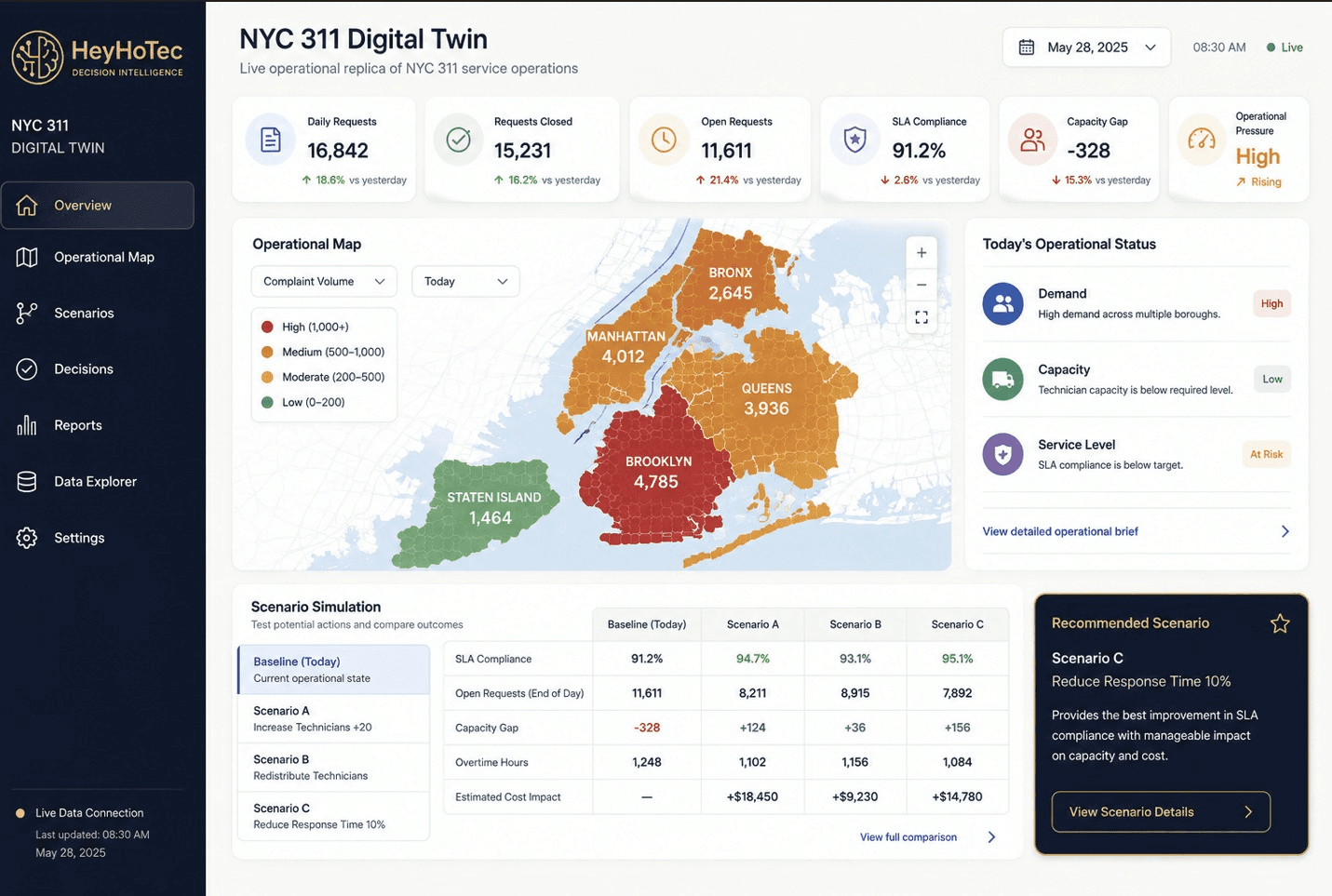
30-second demo
Demo placeholder — short video will appear here when approved for public release.
Business problem
Organizations often rely on historical dashboards that explain what has already happened. Decision-makers need a way to understand the current operational state, anticipate future conditions, evaluate alternative scenarios, and reduce operational risk before decisions are executed.
Business outcome
The Operational Digital Twin enables organizations to simulate operational scenarios, evaluate the impact of alternative decisions, improve service levels, optimize resource utilization, reduce operational costs, and support data-driven executive decision-making through continuous operational intelligence.

Protected demonstration
Enter the access password shared with you to watch this demo. The same password is used for invited clients.
Business problem
Organizations generate large volumes of operational data, yet critical decisions remain fragmented across dashboards, alerts, spreadsheets, and human judgment. Traditional analytics can explain what happened, and predictive systems can estimate what may happen next, but they often stop before helping managers decide what action to take and learn from the outcome.
Business outcome
ODIP connects operational intelligence with decision-making in a closed loop. It helps organizations identify emerging risks, evaluate recommended actions, retrieve relevant past experiences, capture human decisions, measure outcomes, and continuously build organizational decision knowledge.

Protected demonstration
Enter the access password shared with you to watch this demo. The same password is used for invited clients.
Business problem
Organizations generate large volumes of operational data, but much of their operational experience is never preserved as structured knowledge. Dashboards show metrics and current performance, while the context behind those numbers what conditions existed, what risks emerged, what actions were recommended, what managers decided, and what happened afterward is often fragmented or lost. Over time, organizations accumulate data without necessarily building a reliable memory of how their operations actually behaved.
Business outcome
OER transforms operational activity into a persistent, searchable history of organizational experience. By connecting operational conditions, resources, performance, risks, recommendations, decisions, outcomes, and lessons over time, organizations can identify recurring patterns, understand how operations respond under different conditions, preserve institutional knowledge, and build the foundation for evidence-based operational strategy, organizational learning, and continuous improvement.
Next step
Book a Discovery Meeting. Explore how Decision Intelligence can adapt to your organization's operational reality.