
Today, almost every business knows it needs a digital presence. But having a website, a management platform, a CRM, or even an ERP system does not necessarily mean that a business is intelligent. These systems solve different problems, and understanding the difference can help organizations make better technology investments. Let's make it simple by following one example: a travel agency.
Level 1 - Website: Your Digital Front Door
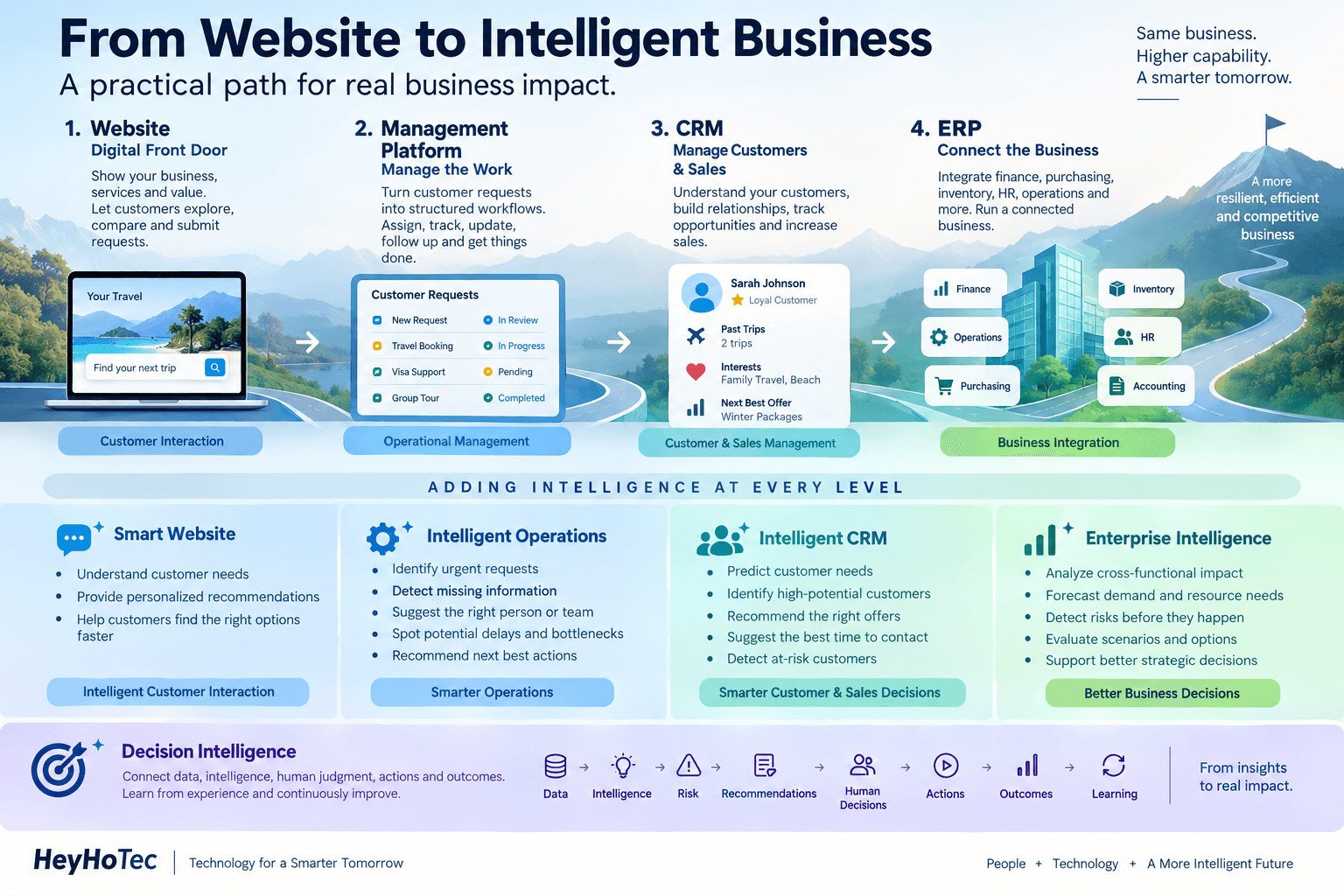
A website is usually the first digital connection between a business and its customers. For a travel agency, customers may visit the website to explore destinations, review services, compare available options, check prices, and submit a booking or service request.
The website helps the customer interact with the business. But an important question comes next: What happens after the customer submits a request? That takes us to the next level.
Level 2 - Management Platform: Managing the Work
Once a customer request enters the organization, someone has to manage it. The request may need to be reviewed, assigned to an employee, updated, tracked, approved, paid, documented, and eventually completed. A management platform helps organize and control this operational workflow. Instead of managing requests through disconnected emails, spreadsheets, messages, and manual follow-ups, the business can manage the process through one structured system.
In simple terms:
- Website: manages the interaction with the customer.
- Management Platform: manages the work behind that interaction.
Level 3 - CRM: Managing Customers and Sales
CRM (Customer Relationship Management) is actually a specialized type of management system focused on customers, relationships, and sales. A CRM can help the travel agency understand:
- Who is this customer?
- What services have they purchased before?
- What conversations have we had with them?
- What are they interested in?
- Are there open sales opportunities?
- When should we follow up?
Instead of seeing every booking as an isolated transaction, the business begins to understand the relationship with the customer over time.
Level 4 - ERP: Connecting the Business
As a company grows, managing individual processes is no longer enough.
- Sales affects finance.
- Purchasing affects inventory.
- Operations affect staffing.
- Customer demand affects resources.
ERP (Enterprise Resource Planning) systems help connect different parts of the organization such as finance, accounting, purchasing, inventory, human resources, sales, and operations through an integrated environment.
At this stage, the organization moves from managing separate processes toward managing a connected business system. So, at a very simple level:
- Website = Digital Front Door
- Management Platform = Manage the Work
- CRM = Manage Customers & Sales
- ERP = Connect the Business
But there is an important distinction.
Digitalization Is Not the Same as Intelligence
A company may have a modern website, a sophisticated CRM, and a large ERP system and still rely heavily on people to interpret information, identify problems, predict what may happen next, and decide what action to take.
Digital systems help us capture, organize, and connect information. Intelligent systems go further. They help us understand, predict, recommend, and make better decisions. So what happens when intelligence is added to each level?
Level 1 - From Website to Smart Website
In a traditional website, customers search through pages, services, and options themselves. A smart website can understand what the customer is looking for and help them reach the right solution faster. For example, instead of searching through dozens of travel packages, a customer might simply say:
“I'm looking for an affordable one-week warm-weather vacation for a family of four in late December.”
An intelligent system can understand the request, identify relevant options, compare alternatives, and provide personalized recommendations. The website moves from simply showing information to helping the customer find the right answer.
Smart Website → Intelligent Customer Interaction
Level 2 - From Management Platform to Intelligent Operations
Now imagine that the customer's request has entered the company. A traditional management platform records and tracks the request. An intelligent management platform can help understand what is happening inside the workflow. It may identify:
- Which requests are urgent?
- Which documents are missing?
- Which employee or team should handle the case?
- Which cases are likely to be delayed?
- Where is a bottleneck developing?
- What should happen next?
Instead of simply recording operations, the system begins to understand and support operations.
Intelligent Management Platform → Smarter Operations
Level 3 - From CRM to Customer Intelligence
A traditional CRM stores customer information, interactions, leads, and sales activities. An intelligent CRM can use that information to understand patterns and anticipate needs. For example, it may help identify:
- Which customers are more likely to buy?
- Which service is most relevant to a particular customer?
- When is the best time to contact them?
- Which customers may be at risk of leaving?
- Which sales opportunities deserve immediate attention?
The CRM moves from being primarily a system of customer records toward becoming a source of customer intelligence.
Intelligent CRM → Smarter Customer & Sales Decisions
Level 4 - From ERP to Enterprise Intelligence
At this level, intelligence extends beyond one customer or one workflow. It begins to look across the organization. Imagine that demand for winter travel packages is increasing rapidly. A traditional ERP may show the increase in sales and its impact across different business functions. An intelligent enterprise system can go further. It can analyze how increasing demand may affect staffing, cash flow, supplier capacity, operational workload, service quality, and profitability. It may identify a future problem before it happens. For example:
“Based on the current booking trend, the reservation team may exceed its operational capacity within two weeks. Adding temporary capacity could reduce the expected service delay.”
Now the system is no longer only telling managers what has happened. It is helping them understand:
- What is happening now?
- What is likely to happen next?
- What risks are developing?
- What options do we have?
- What action may produce a better outcome?
Enterprise Intelligence → Better Business Decisions
The Next Step: From Intelligence to Decision Intelligence
This is where evolution becomes especially important. The goal is not simply to add AI features to every piece of software.
- A chatbot does not automatically make a business intelligent.
- A prediction does not automatically lead to a better outcome.
- An AI recommendation has limited value if the organization cannot connect it to the operational context, the decision made, the action taken, and the resulting outcome.
The next generation of business systems moves toward Decision Intelligence:
“Turning business data and AI insights into better decisions and measurable outcomes.”
It helps organizations identify risks earlier, evaluate the best options, take informed action, and continuously improve based on results.
From Digital Business to Intelligent Business
The evolution can therefore be understood as a journey:
1.Digital Presence
Website
2.Digital Operations
Management Platforms
3.Customer & Business Management
CRM and specialized business systems
4.Enterprise Integration
ERP and connected systems
5.Intelligent Operations
AI, forecasting, risk detection, recommendations, and automation
6.Decision Intelligence
Connecting data, intelligence, human judgment, actions, outcomes, and learning
Not every business needs to start at the final level. And not every organization needs a large ERP or a complex AI platform. The right starting point depends on the business, its current systems, its operational challenges, and the decisions that matter most. The important question is no longer simply:
“Do we need a website, CRM, ERP, or AI?”
A better question is:
“Where is our business today, and what is the next level of capability that would actually improve how we operate and make decisions?”
Because technology itself is not the destination.
Better operations, better decisions, and measurable outcomes are.